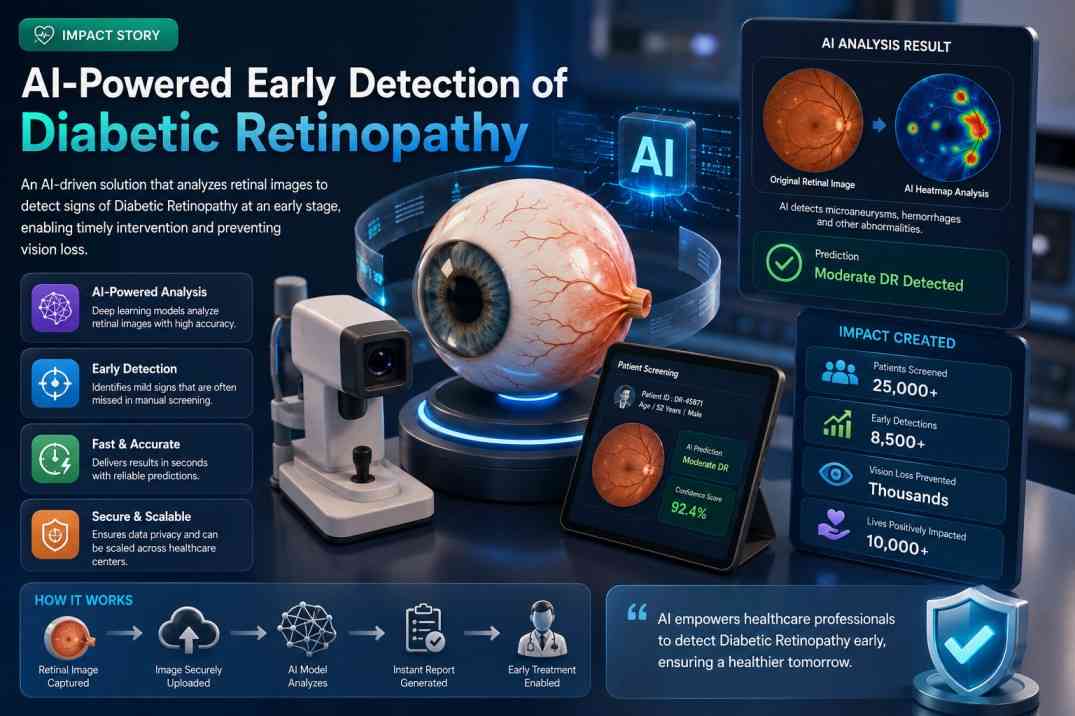
MediSense AI Technologies developed and deployed an AI-powered medical screening solution to support the early identification of diabetic retinopathy at partner healthcare facilities. The initiative was designed to address the growing need for efficient, technology-assisted screening methods that can help healthcare professionals analyze retinal images and identify patients who may require further clinical evaluation.
Diabetic retinopathy is a condition that can develop in people with diabetes and may cause serious vision problems if not identified and managed at an appropriate stage. Early screening and timely clinical evaluation are therefore important components of effective eye-care programs. However, healthcare facilities may face challenges such as increasing patient volumes, limited availability of specialized expertise, time-consuming image analysis, and difficulties in providing screening services across different locations. MediSense AI Technologies sought to address these challenges by introducing an intelligent image-analysis platform that could assist healthcare teams during the screening process.
The solution uses artificial intelligence and machine-learning techniques to analyze retinal images and identify visual patterns that may be associated with diabetic retinopathy. Retinal images captured during screening can be securely submitted to the platform, where the AI system processes the images and generates analytical results. The system is designed to support healthcare professionals by highlighting potentially abnormal findings and providing structured information that can assist them in determining whether additional clinical assessment may be appropriate.
The implementation at partner healthcare facilities introduced a more streamlined approach to retinal-image screening. Instead of relying entirely on time-intensive manual analysis, healthcare teams could use the AI-assisted platform as an additional screening and decision-support tool. This helped reduce the effort required to review large numbers of retinal images and enabled professionals to prioritize cases that may require closer attention.
A centralized digital workflow also helped improve the organization of screening information. Healthcare professionals could access relevant image-analysis results through a structured interface, review patient-related screening information, and use the available insights to support appropriate referral decisions. The platform was designed to complement, rather than replace, professional medical judgment, with final diagnosis and treatment decisions remaining with qualified healthcare professionals.
One of the important outcomes of the initiative was improved efficiency in the preliminary screening workflow. By automating portions of the image-analysis process, the solution helped healthcare teams process retinal images more efficiently and focus their attention on cases requiring further evaluation. This approach has the potential to support healthcare facilities that need to manage increasing screening volumes while maintaining a consistent technology-assisted workflow.
The project also demonstrated how artificial intelligence can be applied to healthcare challenges where large volumes of visual medical information need to be reviewed. AI-based image analysis can assist in identifying patterns that may be difficult or time-consuming to assess manually, particularly when screening programs involve a significant number of patients. The MediSense platform provides a technology layer that can help organize this process and deliver consistent analytical assistance to healthcare teams.
Another important aspect of the initiative was the potential to support earlier referral pathways. When the system identifies retinal images containing patterns that may warrant additional clinical attention, healthcare professionals can review the findings and determine whether the patient should be referred for further examination. This can help create a more structured pathway between initial screening and specialist evaluation.
The implementation also highlighted the importance of combining advanced technology with healthcare expertise. Rather than functioning as an independent diagnostic system, the solution was positioned as an AI-assisted screening and decision-support platform. Healthcare professionals remain an essential part of the workflow, providing clinical context, reviewing results, communicating with patients, and making appropriate decisions regarding further examination and care.
The initiative contributed to the broader adoption of digital healthcare technologies by demonstrating a practical application of artificial intelligence in medical screening. It showed how AI, medical imaging, cloud-based platforms, and digital dashboards can work together to create more efficient healthcare workflows. Such technologies can be particularly valuable in environments where healthcare professionals need tools that can assist them in handling large amounts of information without significantly increasing their workload.
From an operational perspective, the solution can support a scalable screening model in which retinal images from multiple healthcare facilities can be processed through a common technology platform. Such an approach can help organizations standardize digital screening workflows, monitor screening activity, and generate structured information for further analysis. With appropriate infrastructure, security controls, and clinical validation, similar approaches can potentially be extended to additional healthcare facilities and screening programs.
The project also emphasizes the importance of responsible AI implementation in healthcare. Medical AI solutions must be developed and used with careful consideration of data security, patient privacy, model reliability, transparency, and clinical oversight. MediSense AI Technologies focused on providing technology-assisted insights while maintaining the role of qualified healthcare professionals in reviewing results and making clinical decisions.
The initiative has broader implications for preventive healthcare and digital health innovation. By supporting more efficient screening workflows, AI technologies can help healthcare organizations explore new approaches to identifying potential health risks earlier and directing patients toward appropriate clinical services. The combination of AI-assisted analysis and professional medical expertise can contribute to more organized and responsive healthcare delivery.
The project also provides opportunities for continued improvement and research. Future development can focus on expanding the range of retinal conditions that can be analyzed, improving model performance through validated datasets, strengthening interoperability with healthcare information systems, enhancing reporting capabilities, and developing more accessible tools for screening programs. Integration with remote healthcare and telemedicine workflows could further extend the reach of technology-assisted screening.
For healthcare professionals, the platform provides an additional layer of analytical support that can help manage screening workloads and organize retinal-image assessment. For healthcare organizations, it offers the potential to improve workflow efficiency and develop more structured screening processes. For patients, the broader objective is to support timely identification of potential retinal abnormalities and facilitate appropriate follow-up with qualified medical professionals.
The MediSense AI Technologies initiative demonstrates the potential of artificial intelligence to support practical healthcare challenges through intelligent image analysis and digital workflows. By combining AI technology with medical expertise, the project aims to make screening processes more efficient, scalable, and accessible while maintaining appropriate clinical oversight.
Overall, the AI-Powered Early Detection of Diabetic Retinopathy initiative represents an important step toward technology-enabled preventive healthcare. It demonstrates how emerging AI capabilities can be translated into practical healthcare applications that support professionals, improve information processing, and strengthen referral workflows. The project provides a foundation for continued innovation in AI-assisted medical screening and contributes to the development of more intelligent, connected, and efficient digital healthcare ecosystems.